


Cavity wall insulation and your EPC rating
Insulation inside a cavity wall can't be seen, so an EPC counts it only where there are signs of the fill on the walls or paperwork for it. Without either, the wall is assessed as built, with the insulation a wall of its age would be assumed to have. For an older home that difference is large, and for a home built from 1996 on the method's values for England are the same.
Does cavity wall insulation improve your EPC rating?
For a cavity wall in a home built before 1996, a proved fill does. In RdSAP 10, the method for existing homes, each wall has a U-value, its heat-loss value, set by the home's age where nothing better is known. In its table for England, a filled cavity wall in a home built before 1983 has less than half the value of the same wall as built, and from 1983 to 1995 a little over half. From 1996 on, the two values are the same.
How many points that adds depends on the home: how much outside wall it has, against its roof, floor and windows, and how it is heated. And a fill goes on the EPC's recommendations only if it would raise the score by at least 1 point, and the method looks at it only for a wall recorded as built and suitable for filling, with a heat-loss value above 0.7. In England that leaves out a cavity wall in a home built from 1983 on.
When the EPC does recommend filling a cavity, the assessment also notes whether the cavity may be narrower than 50 mm, the walls highly exposed to the weather, or hard to reach. If any of those apply, the EPC adds a note that they should be looked into first.
Is it a cavity wall?
Homes built after the 1920s probably have cavity walls. Where the brick shows, a cavity wall usually has every brick laid lengthways, and a solid wall has some laid end on, so you can see their short ends. A brick wall between 260 mm and 350 mm thick is likely to be a cavity wall. If the walls are rendered or clad, the brick can't tell you.
What proof of cavity wall insulation does an EPC need?
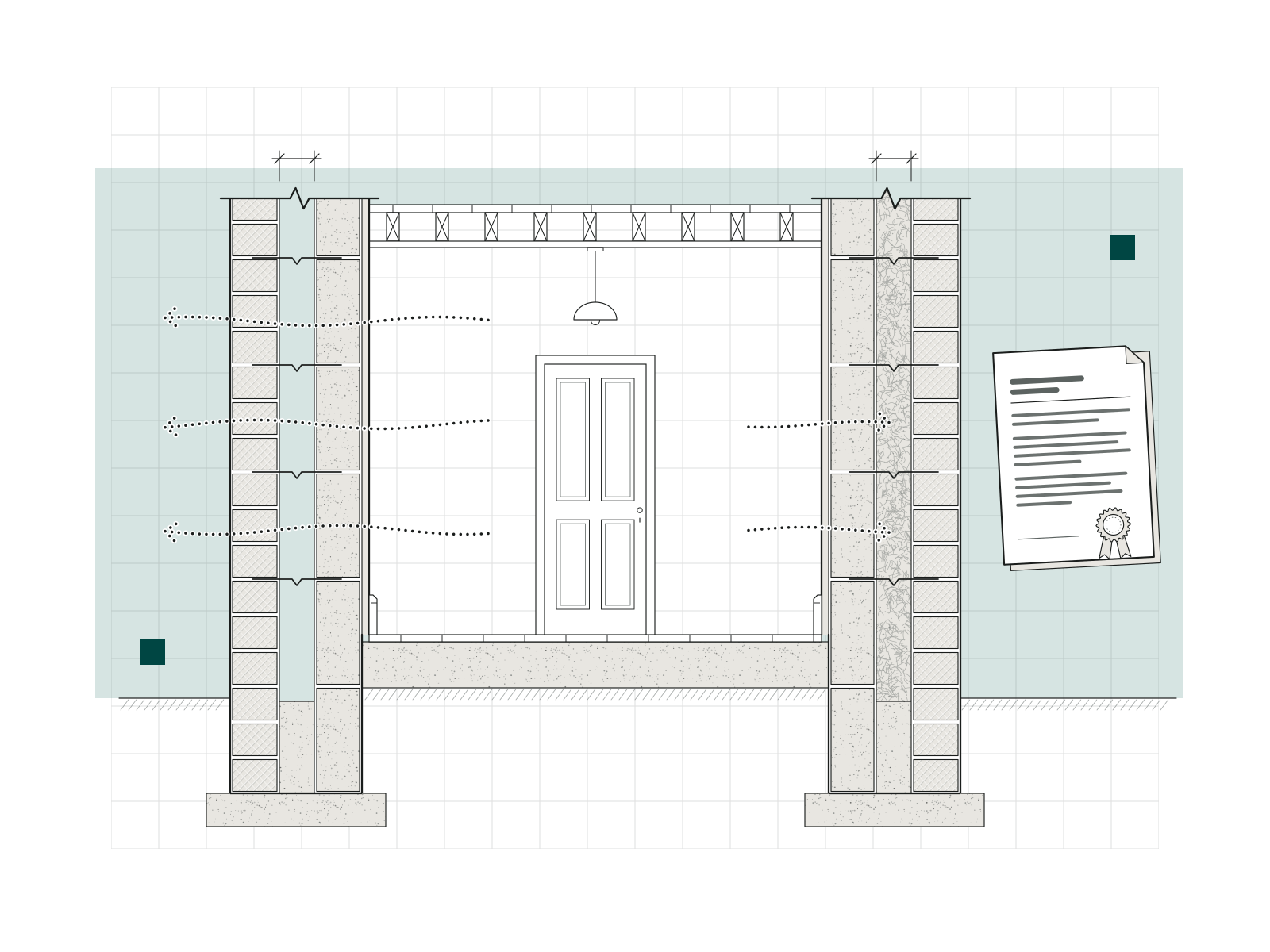
Where signs of the fill can be seen, they come first: we look for the pattern of drill holes the fill left in the outside walls, and photograph it. Paperwork covers what can't be seen, such as walls under render.
Counts
- A guarantee for the fill, such as the 25-year guarantee CIGA gives for work by its registered installers
- The installer's certificate or warranty
- Other documents showing the work was done at this home, such as official letters from the housing association that owns the home
Doesn't count on its own
- A quote, or any other sign that the work was planned
- Papers for a different address
- Papers that the home itself contradicts
Whatever the document, the assessor has to be able to show it relates to this home or to the work done, and nothing in the home or in other papers can contradict it. With no signs and no paperwork, the wall is recorded as built, and that is also what lets the EPC recommend filling it.
How do I get a cavity wall insulation certificate?
From whoever guaranteed the work. If you can't find a CIGA guarantee, CIGA can confirm the cover, or send a copy for a fee, once you show you own the home, with a recent utility bill among the proof. The guarantee stays valid for later owners and occupiers, so a buyer can ask the seller for it.
Not every fill has a CIGA guarantee: another guarantee provider may cover it. If you don't know who did the work, the paperwork from when you bought the home is a place to look.
Internal and external wall insulation
A solid wall has no cavity to fill, so it can be insulated only on the inside or the outside. Where there is evidence of that insulation, the assessor can record its thickness, or mark it as insulated to an unknown thickness, which the method then fills in with a default. A U-value worked out for the wall can replace the method's only with documents for this home that show how it was calculated. Plasterboard on the inside of a wall isn't proof on its own that there is insulation behind it, so keep the paperwork for the work.
The EPC shows what the method expects: if wall insulation is among its recommendations, the potential rating is how energy efficient the home could be after all of them are made. A thin solid brick wall loses heat faster than a thick stone one, so it may gain more from insulating.