


Loft insulation and your EPC rating
At an EPC visit the assessor measures how deep the loft insulation is, and the roof is assessed by that depth. Where the loft can't be reached, or the insulation can't be seen, and there's no document for it, the method uses a value for a roof of the home's age instead. A top-up can be recommended where an accessible loft has 150 mm or less and the top-up would raise the score by at least 1 point, and the first layers of insulation count for far more than later ones.
How thick should loft insulation be for an EPC?
An EPC records the depth it finds and, where that depth is thin, recommends more. RdSAP 10, the method for existing homes, looks at loft insulation for any accessible loft in a pitched roof of slates or tiles, insulated at ceiling level with 150 mm or less, and the improvement it works out is a top-up to 270 mm.
The main roof and each extension's roof are looked at separately, so a thin loft over a rear extension can bring its own recommendation. And a loft recommendation goes on the EPC only if it would raise the score by at least 1 point.
How does the assessor know what's in the loft?
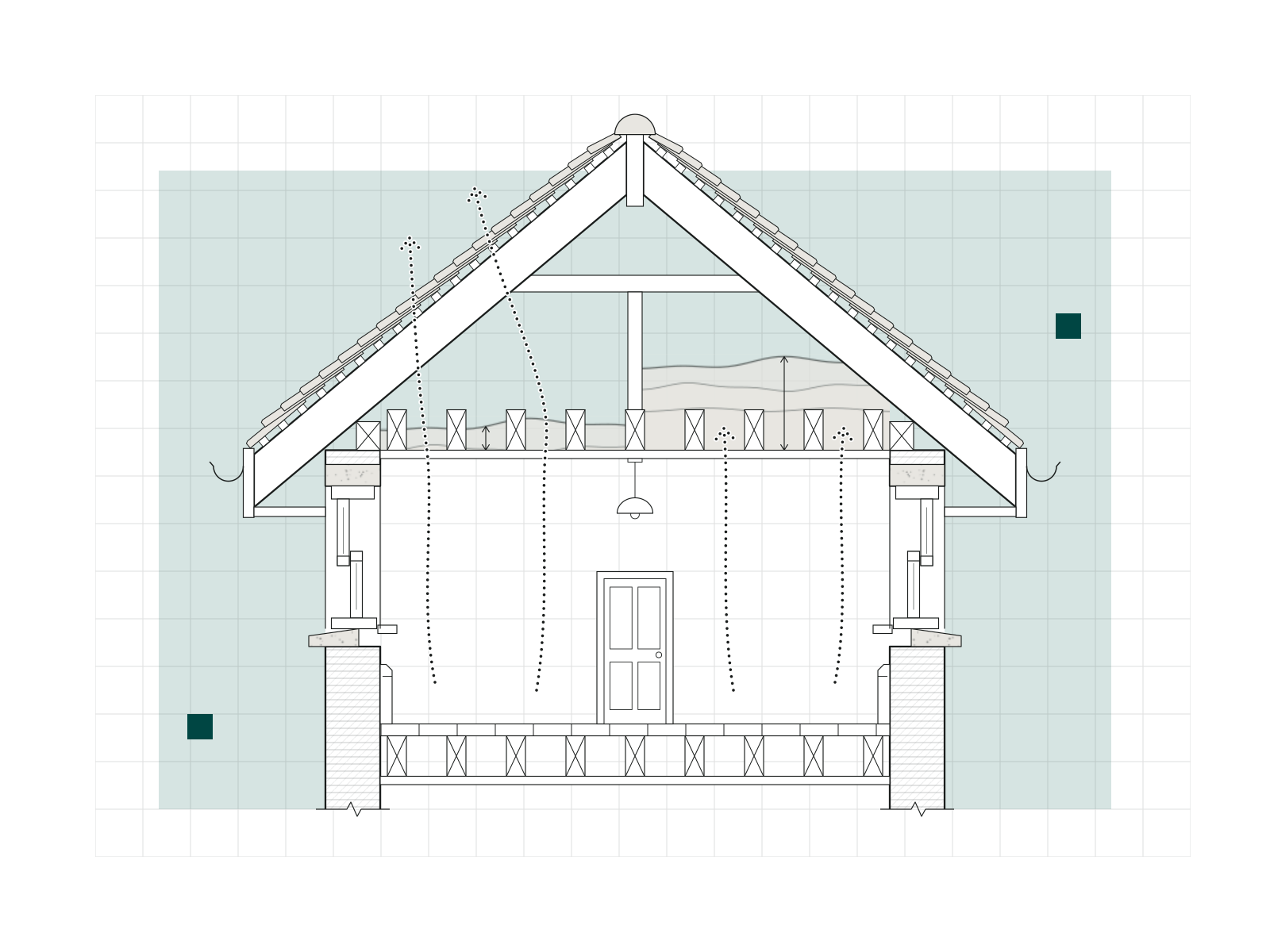
By going up and measuring it. Where the loft can be reached safely, we measure the depth of the insulation, photograph it, and photograph the loft as a whole to show that depth carries on across it. The EPC then describes the roof, with any insulation found or assumed.
Insulation between the joists counts as between them up to 150 mm, and as between and over them beyond that. If there is insulation at the rafters as well as at the joists, only the joists' insulation is recorded.
A room in the roof can have its own age recorded, and the insulation on its flat ceiling is measured where it can be.
What if the loft can't be reached, or it's boarded?
Then the depth can't be measured, and the method uses a value for a roof of the home's age. That applies when there is no hatch, and when there is one that can't be used on the day, such as a hatch painted shut or blocked.
A loft that is fully boarded, or covered by things stored in it, counts the same way, unless the boards are lifted or the things moved so that the insulation can be seen, or you have a document for the insulation work. A document for a boarded loft counts for no more than the depth of its joists.
If only part of the loft is boarded and the insulation can be seen running under the boards in several places, through gaps or from the edges, the boarded part counts at the depth that can be shown.
Insulation beyond what the home's age would suggest can be recorded where there is good evidence of it. So keep the paperwork for any loft insulation work: a certificate, a guarantee or another document showing the work was done at this home.
Does loft insulation improve your EPC rating?
Where heat is lost through the roof, yes. A house or bungalow has a completely exposed roof, and so does a top-floor flat. A flat with another home above it loses no heat through its ceiling, so there is no loft to count.
How many EPC points does it add?
It depends on the home. The rating is based on the modelled cost of heating, hot water and lighting, so the gain depends on how much of the home's heat goes through its roof, how deep the insulation is now and how the home is heated.
And the first layers count for most. In RdSAP 10's own table, a roof's U-value, its heat-loss value, falls from 2.3 with no insulation to 0.40 at 100 mm, and from 0.16 at 270 mm to 0.11 at 400 mm or more. So topping up a thin loft counts for far more than adding to a thick one.
Which loft insulation counts?
The depths in the method's table are for mineral wool or expanded polystyrene insulation. Other kinds, such as multifoil or foam, are assessed by RdSAP 10's conventions, so keep the product's paperwork for the visit.
| Check | Why it helps |
|---|---|
| A clear way to the loft hatch | The depth can be measured only where the loft can be reached safely |
| Boards lifted, or stored things moved, in a few places | Insulation that can be seen can be measured |
| The paperwork for any loft insulation work | A document can show insulation that can't be seen |
| Tell us about a room in the roof, or insulation at the rafters | Each is recorded in its own way |
Our list of what to have ready for the visit covers the rest of the home.