


Why your EPC rating differs from your neighbour's
Each EPC rates one home, from what the assessor found there and the proof they were shown, using the version of the method that applied on the day. Your neighbour's home can differ from yours in how much of it faces the outside, in its insulation, windows and heating, and in the paperwork its owner kept. And the two EPCs may be years apart: an EPC stays valid for 10 years, and the method for existing homes changed in June 2025.
What does the rating leave out?
The people living there, and how they live. The rating is worked out for a standard household, so who lives in the home, how many appliances they have and how warm they keep it make no difference, and nor do today's energy prices: the method uses its own set prices. So a neighbour's lower bills don't mean a better rating.
What it counts is the home itself. The assessor records its type, its age, its size, what it's built from, its insulation, its windows, and its heating and the fuel that heating uses. Government-approved software then works out what the home's heating, hot water, ventilation and lighting would cost to run, and turns that into a score from 1 to 100. The lower the running costs, the higher the score.
The score is adjusted for floor area, so a bigger home doesn't rate lower than a smaller one of the same type just for its size.
Why is my EPC rating different?
Two homes can look alike from the street and still differ in the things the rating counts. These are the differences to look for.
How much of the home loses heat
In the assessment, heat is lost through walls, roofs and floors that face the outside, the ground or an unheated space, and none is lost through a floor or ceiling shared with another home. So where a home sits matters. An end-terrace house has three outside walls where a mid-terrace has two, so the house at the end of a row has more wall losing heat than the same house in the middle. Every house has its own roof and ground floor.
Flats vary more. A flat with another flat below it loses no heat through its floor, and one with another flat above it loses none through its ceiling. A flat over an open passage, a garage or a shop does lose heat through its floor, and a top-floor flat loses heat through its roof. A wall onto an unheated stairwell or corridor counts as partly exposed. So two flats in one block, with the same layout, can be rated differently.
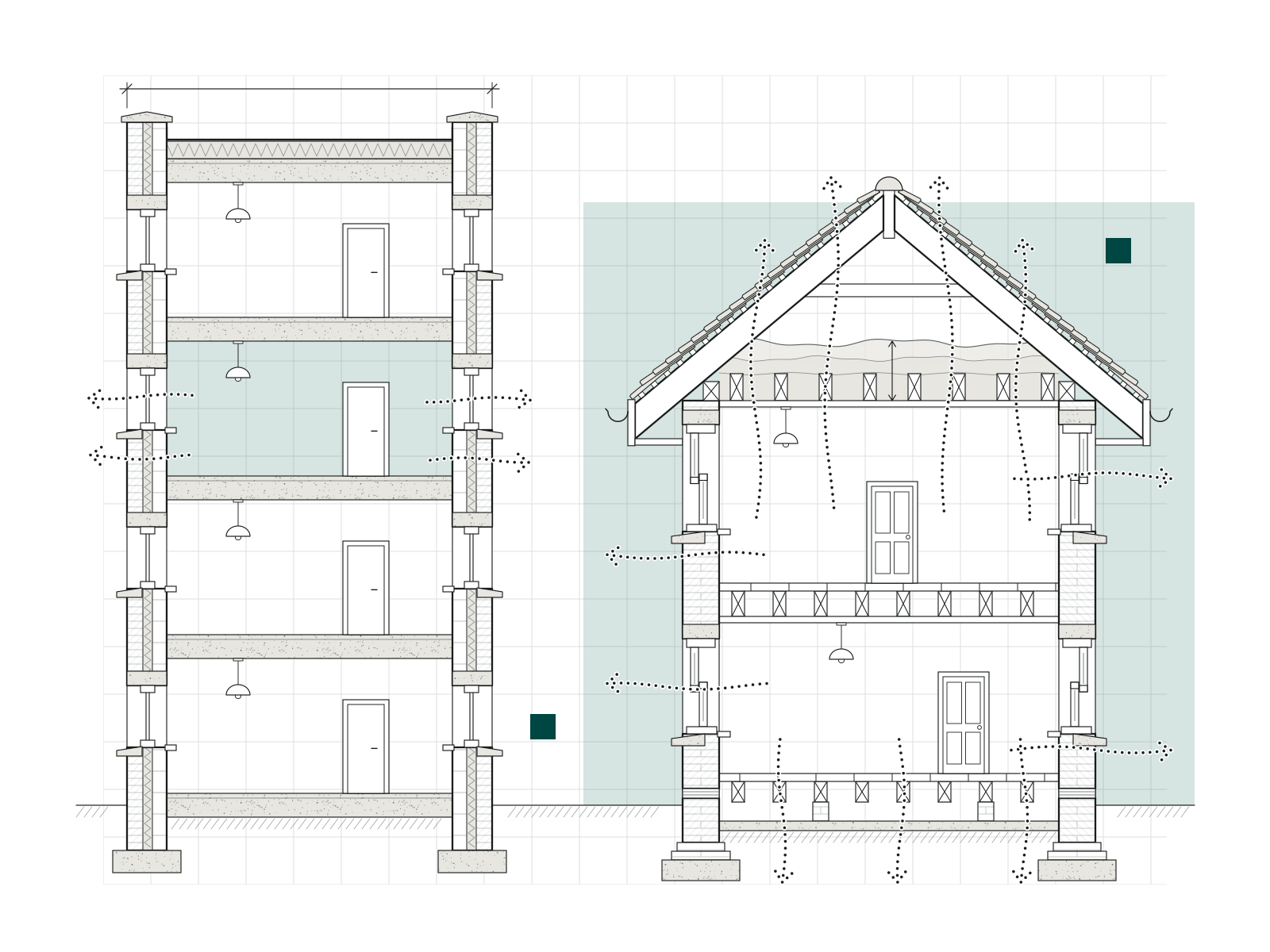
Across England and Wales, flats and maisonettes have the highest median score of any type of home: 74, a C, in the 10 years of EPCs to March 2025.
Insulation, and the proof of it
Some insulation can't be seen at a visit, such as in a cavity wall or under a floor. Without proof, such as receipts, the assessor can't record it, and the method assumes what a home of that age would have. Proof changes that: insulation beyond what the age would suggest can be recorded where there's evidence of it. So paperwork kept by one owner and not the other can be enough to give two identical homes different ratings.
Gas or electric heating
Electric heating can lower a rating. The rating is worked out from running costs at the method's standard price for each fuel, and electricity usually costs more per unit than gas. So a home heated by electricity can rate lower than a similar home heated by gas, even when its heating is efficient. For example, two flats in one block can differ this way: one heated by a gas boiler, the other by electric heaters. The tariff counts too, such as an off-peak tariff for storage heaters, and so do the heating's efficiency and its controls.
Extensions and loft rooms
An extension or a room in the roof can have its own age recorded, and the insulation assumed for it goes by that age. So a rear extension or a loft conversion next door can change that home's rating in a way yours doesn't share.
When each EPC was done
An EPC stays valid for 10 years, so next door's may have been done years before yours, on an earlier version of the method. The version for existing homes changed in June 2025. Compare the dates before you compare the ratings.
Can one point change the letter?
Yes. Each letter covers a range of scores, and the EPC gives the score as well as the letter.
| Score | Rating |
|---|---|
| 92 or more | A |
| 81 to 91 | B |
| 69 to 80 | C |
| 55 to 68 | D |
| 39 to 54 | E |
| 21 to 38 | F |
| 1 to 20 | G |
So a letter can hide how close two homes are. For example, a home scoring 80 is a C and one scoring 81 is a B, a point apart, while homes scoring 69 and 80 are both a C. A home that generates its own energy can score more than 100.
Can an EPC rating go down?
Yes. A new EPC is a fresh assessment, and an EPC is valid for 10 years or until a newer one is made for the same home, so the newest one is the one that counts. A new rating can come out lower than the last one for these reasons:
- The method changed in June 2025. The current version measures every window and updated all its tables of heat-loss values, so a new EPC can come out differently from one done on the earlier version, even when nothing in the home has changed.
- Proof the last assessor saw isn't there this time, so insulation that can't be seen is assumed from the home's age.
- Something in the home changed, such as the heating moving from gas to electricity.
- The home was new when its last EPC was done. A new home's EPC comes from the method for new homes: the assessor works from its specifications, checks the finished home and tests it for air leakage, and that method's fuel prices can differ from the ones used for existing homes. Later EPCs use the method for existing homes, where details that can't be seen may be assumed from the home's age or construction type.
Higher energy bills aren't one of the reasons. The prices behind the rating are set in the method, and the current version for existing homes uses the same ones as the 2012 method.
If you'd like to know a home's rating privately first, an EPC Pre-Assessment is an EPC assessment that isn't published on the government register. A pre-assessment isn't a retrofit assessment, and it isn't an EPC. It can't be used to market a sale or a let, or to show that a rented home meets the minimum energy efficiency standard.
How do I check a property's EPC rating?
On GOV.UK's find an energy certificate service, where EPCs on the register are free to view and download. You can search by postcode, street name and town, or certificate number.
Find an energy certificate on GOV.UK
Each EPC gives its date, the home's property type and total floor area, and lists its features, each with a description and a rating from very good to very poor. Where the assessor couldn't inspect a feature, its rating is assumed from the home's age and type.
To see why two ratings differ, yours and next door's, or your new one and your last, open both and compare them line by line, in this order:
| Compare | What a difference can mean |
|---|---|
| The date | One done before June 2025 used an earlier version of the method. |
| The score beside the letter | A point either side of a band's edge changes the letter. |
| The type of home | An end-terrace has three outside walls, a mid-terrace two. A flat's heat loss depends on what is below, above and beside it. |
| The floor area | A big gap between two similar homes can mean an extension or a loft room, or a measurement worth checking. |
| Walls, roof and floor | Insulation seen or proved on one home, against insulation assumed from the age of the other. |
| Windows | Single or double glazing, and how much of it. |
| Heating, fuel and controls | A different fuel or tariff can move the rating, even with the same insulation. |
| Hot water | How the home heats its water, such as by a gas boiler or an electric immersion heater. |
| Solar panels | Listed under low and zero carbon energy sources. Savings from energy generated on site count towards the score. |
If a detail on your own EPC doesn't match your home, the certificate service says you can complain to the assessor who created it, and if you're still unhappy, to the assessor's accreditation scheme.